
Hugelkultur
Updated: Apr 14
Building soil, increasing water retention and changing the possibilities of gardening in shallow earth.

Contents:
Very early on in my ecological gardening journey I came across the concept of “hugelkultur”, and soon saw the concept repeated in many places, from books, to homesteads I volunteered on, and YouTube garden tours. It is a German word that translates to “mound bed” or “mound culture”. It was popularized in permaculture circles in the 2000’s by Austrian farmer Sepp Holzer. I suspect there are cultures throughout the world and time that have used similar practices for growing food. Hugelkultur is a style of raised bed made of wood covered in soil. The basic idea is that as the wood breaks down the quality of the bed increases, through higher moisture retention, nutrient availability, with the mound eventually becoming a rich soil high in organic matter. The mound will drop in height gradually over time.
A Brief Philosophy of Hugelkultur
Hugelkultur mimics the build up of wood on forest floors from fallen trees that can become 'nurse logs', basically logs that begin to rot that young trees grow out of, using the wet spongy decaying log as a strong start to life. Using this as inspiration and burying the wood first, we can speed up the decomposition process, and mimic this process to some degree in our own gardens. Mimicking natural processes like this is core to the permaculture play book, as well as any grounded way of growing food.
Another benefit to hugelkultur besides moisture retention and building soil rich in organic matter is the addition of vertical growing space. If you can a 4x10 ft bed, you have 40 sq ft of growing space. If you have a hugelkultur bed with a 4x10 ft base, 4 ft rise on either side, and 1 ft wide top, you now have ninety square feet of growing space, more than double a flat bed of the same footprint! In reality, the bed is unlikely to have completely straight edges, and the gained growing space will vary depending on how high you build the bed, but by building up you will gain growing space. I have the vision of building a hugelkultur seven feet high that can act as a visual break along the road, with little steps going up to a sitting spot on the peak.
So much of modern agriculture relies on flat land, a violence committed to the landscape here in North America committed over the past three hundred years that is at the heart of colonization. While flat field farming that enables big machinery undeniably has benefits and a place in our food system at the moment, there are many well documented draw backs to this current widespread way of farming, including top soil loss, habitat destruction, degrading soil quality, reliance on inputs (pesticide and fertilizer), reliance on machinery and fossil fuels, among more. I believe the practice of agricultural systems that strive to mimic nature and limit soil disturbance is what will keep a thriving human culture around for another couple millennia.
Having texture in your garden or landscape also offers a respite from the flat lawn and field culture that surrounds us daily. Through creating uneven terrain, interesting micro climates can develop, habitat for different plants and animals, and the soul of our gardens takes on a bit more unique life, developing as a one of a kind shape and space that is unique to our specific site.
Building a hugelkultur is something that I’ve wanted to do for awhile, and finally did! I built it with the help of a friend, Galen, and my wife Hayley. It was a lot of fun to make, combining my love of digging holes with a keen interest for hand scale earthworks, all with the promise of building a fertile garden bed.
Considerations When Building a Hugelkultur
Search online and you’ll find dozens of videos and articles telling you how to build a hugelkultur bed. There are some folks who promote this style of garden beds who have some pretty strong opinions about what is the “right” way to do it (a funny thing to have strong opinions on, burying wood!). I think that there are some considerations to understand that have an effect on the way your hugelkultur ages and behaves which are worth wrapping your head around before building one. Understanding these ideas can make the project more successful in the short and medium term. I’ll lay out some considerations out in short form below.
Diameter of wood
The greater the diameter of wood you’re using, the more volume you are adding to your bed, which will increase the bed’s final height. In general, larger diameter wood will also take longer to decompose. Use what you have access to, but larger diameter wood is ideal as it allows you make a bigger bed, have less air pockets to fill in, and you just have to move it once versus many smaller sticks.
Species of tree
The type of wood you are adding to the bed has a huge effect on how it will behave in the early years. Softwoods will break down quicker, while hardwoods will take a bit longer. Ideally avoid rot-resistant trees like White Cedar and Black Locust, as you want the wood to break down. I say the best wood is species that you can get for free locally. Ideally use “junk-wood”- wood that is not useful for other projects, firewood, or is from trees that need to be felled for some other reason. A species mix is good for having different rates of decomposition and different fungal and microbe habitat. I added a mix of species to our bed including, Crack Willow, Red Maple, Ash, Apple, and a small amount of Red Pine.
You’ll also want to make sure any species of tree you use that is known to root from cuttings is well and truly dead before burying it, like Willow. The Willow I used had been laying on the ground for several years and beginning to rot.
Rot progression in wood
Wood from a long dead tree that has been sitting on the soil for a few years and is already rotting will absorb water and allow plant roots to infiltrate it more quickly than greenwood. It will also breakdown quicker, of course. Again, use what you can get for free locally, but a mix of green and aged wood is probably useful.
Avoid voids in the hugelkultur
When you're placing the logs in a mound, fill any air spaces between logs with soil or wood chip mulch. The more contact the logs have with soil, the faster they will break down and begin to absorb moisture and transition to becoming soil. Soil contact with more surface area of the wood means there are more direct pathways for mycelium and soil organisms to come in contact with the logs. Air gaps can also be homes for rodents, which is ideal to limit in the garden.
Nitrogen availability
As high carbon material breaks down in the soil, nitrogen can temporarily become limited. This is because micro organisms that break down carbonaceous materials have nitrogen in their bodies. Their populations grow as they consume carbon based materials, temporarily binding up nitrogen. As the material is broken down, the population decrease, microbes die, meaning the nitrogen is bio-available once again for plant uptake. (A side note: adding carbon to the soil in the form of brown mulches [hay, straw, wood chips, fallen leaves] is essential for supporting the micro-herds that should be our real focus in building healthy soil in our gardens.) So by adding lots of wood into a garden bed, there is likely to be some limited nitrogen levels for the first few years, depending on how rotted the wood was when it was buried. Planting nitrogen fixing plants or adding natural high-nitrogen amendments is a good practice to try and balance this.
Two Types Of Hugelkultur
Hugel-in-a-day
More like Hugel-in-four-months with acquiring material, but the actual construction of the bed did only take a day, thanks to many hands making light work.
I started off by collecting materials over the winter. On the way into town I pass the yard of a local tree service. They have free wood to take from tree removals they have done, so I would pull in on my way home after errands and load up the truck. The only downside here is that the sections of wood were very heavy and hard to move as one person, especially in the snow, and there was no one in the yard to help move them at the times I went. Oh well, scavengers take what we can get. I got a few pickup truckloads of Apple trunks, five to seven feet long and about sixteen inches diameter. I cut these up further for ease of lifting.
I was doing some work splitting firewood for a local guy and got some rounds of mixed hardwood that were rotting and unsuited for firewood, as well as some Pine.
There were also some rounds from a Willow tree and a Red Maple we had felled when we first moved here a few years ago. Much of that wood we used in other projects (garden edges, passive hugelkultur and firewood for the Maple), but there was still some big rounds kicking around I gathered up.
I stashed all the logs I collected near the build site so I didn't have to move it all on construction day. I tried to be strategic and pile it in a way that wouldn't impede work-flow.
Hayley and I decided a good place to build the bed would be on the northern edge of our main annual garden. The soil gets very shallow where the garden ends (only about eight inches of topsoil before bedrock). This should allow us to use this space for food production, with the added benefit of being a visual break from the road.
I reached out to some friends for help digging, and my friend Galen from Understory Florals came by to help out on building day.

We started by digging a trench to bedrock, about four feet wide by sixteen feet long.
Side note here; you definitely don't have to dig a trench to start. You can just start building on grade and get soil from elsewhere to mound on the wood. As we have limited soil around, we decided excavating a trench first would be best, as well as using some wood chip mulch to fill in gaps throughout the process, as I’ll explain shortly.
Once the soil was removed, Galen and I rolled logs in to be the first layer. Biggest logs on the bottom so we didn't have to lift heavy logs up and so there were fewer gaps lower down. Roots will definitely penetrate to this layer of the bed, but I figured I was better to have more soil volume higher up, closer to the exterior of the bed.

We then shovelled wood chips into the gaps, tapping them down with our shovels then adding more so there were as little air gaps as possible.We added some soil onto this, then did a layer of the next size down logs. We laid the logs in a very unorganized way, as opposed to perpendicular stacks. We also put smaller logs and sticks amongst the big ones if the gap between logs allowed it. One source on building hugelkulturs I came across said this gives the mound more “structural integrity” as it all locks together. I’m not sure about that, but it made sense for the varied shape and sizes of the wood we had to do it that way. I think that once mycelium begins to colonize the mound it will all hold together well anyways.
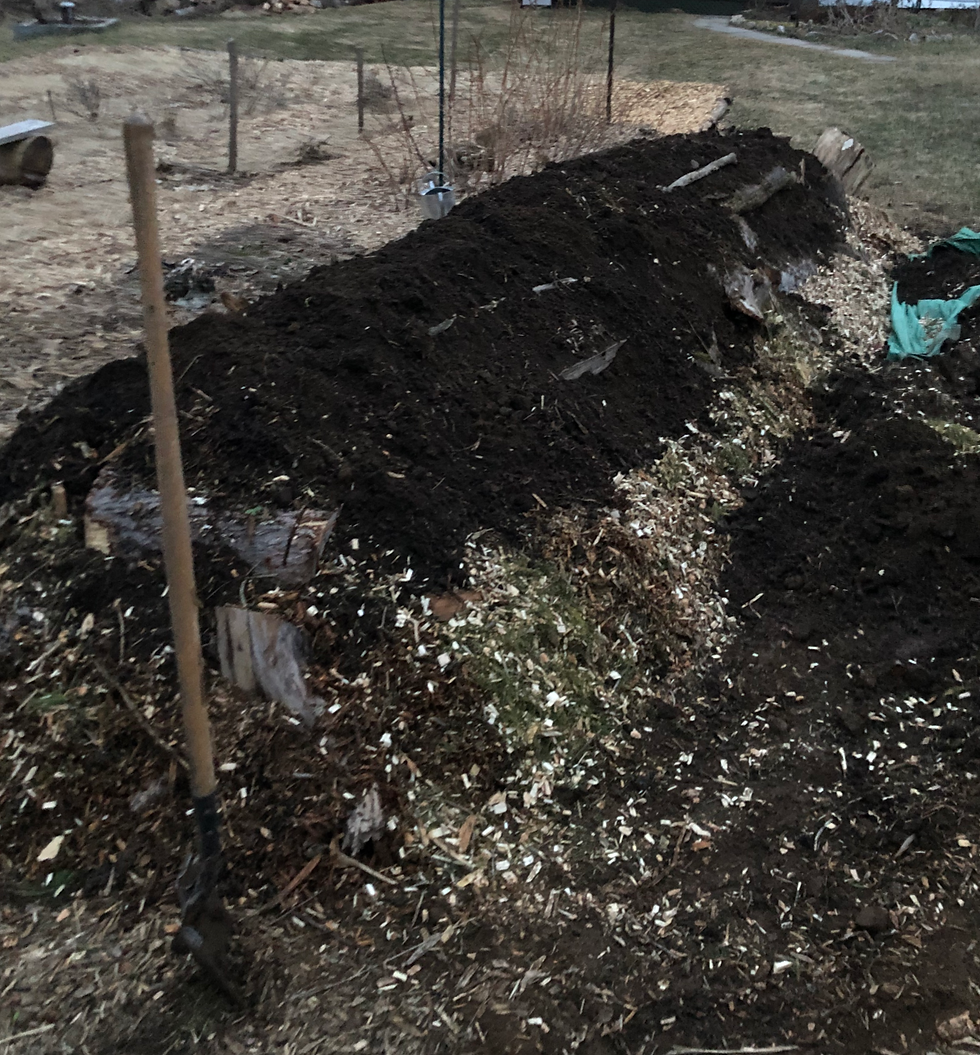
We basically continued this process until there was no wood left and we had four foot high mound. The trickiest bit at this point was getting the soil to stay on the sides of the mound instead of rolling off. To aid in this I strategically placed long narrow logs and some old barn boards horizontally along the sides of the bed at different heights, support with sticks acting as stakes driven into the mound. I then buried these with more soil. In the end there was actually very little exposed wood.
Surprisingly, there was quite a bit of soil left over from such a small trench, even when I was satisfied with the amount of soil on the mound. Hayley suggested we let the bed settle for at least a day before topping it off with the remaining soil.
I waited for a few days (partly because I didn't have time to come back to it), then put the remaining soil on the top and sides of the bed, and finished by mulching the bed with straw cleaned out of the chicken coop. The high nitrogen in the chicken poop will hopefully help with N immobilization in the bed.
All together Galen and I worked for about three hours building the bed, with Hayley and our son popping in to help for about forty-five minutes. I worked for maybe another two hours on the bed topping it up the rest of the soil and mulching it. For just under nine hours of total work hours, I’m really satisfied with the end result- a unique garden bed that holds the potential for decades of rich growing.

Passive Hugel-ing
The other way we are approaching building this style of raised be is much more passive. We began a mound of woody material we refer to as “the hedgerow”, named after the long term plan to plant a bunch of trees into it once it had rotted down. The tree service who cut down the Red Maple and Willow left the Willow pretty messy, with lots of the crown un-chipped. Rather than burn the brush, we thought we would pile it in a row and add more material to it over time. We also added lots of Burdock stems (and seeds…), various other brush and logs, and wood chips when we had a surplus. I would walk along it every once in a while stomping down to get the wood chips in-between the sticks. It got about four feet high by about thirty feet long, but has dropped in height since then. Having a place to put brush and logs rather than burning feels good; we are putting a tiny bit of carbon into the soil rather than the atmosphere. After two-three years the beds actually aging nicely with lots of mycelium, and soil forming from the wood chips. I think mulching with wood chips has been key to moving the bed along, allowing it to stay wet and biologically active. Right now we are in the process of forming pockets in the bed and filling them with soil from our hand-dug pond project to plant into this spring. We will plant a Plum, Seaberry shrubs, and lots of Squash there to start.
The benefit to this style of building the hugelkultur versus all at once is that we could just dump material over time, with no expectation to grow in it. One downside is the pile was a home to some rodents who used it as an alternative to their nest under the chicken coop. This just made managing their population a bit more challenging for us in terms of where to set traps, etc. A brush pile is great habitat, whether we want it or not.
Hugelkultur Maintenance
Like all good things in life, hugelkultur beds get better with time. With a little bit of guidance we can likely make them better sooner.
It's a good idea to water the hugelkultur after building it, if you're constructing during the summer. We built our's mid-March, so it has gotten plenty of rainfall and will get plenty more before we plant into it, so I didn't water it. Irrigating it or letting it get soaked after building it will help soil settle, aid with initial water retention, and help the micro-biological pioneers start doing their thing.
Planting into the hugelkultur bed as soon as possible is a good idea, getting root penetration started. I've read some people advise planting cover crops, especially nitrogen fixers, into the bed for at least part of the first season. We are going to plant veggies into it this year, and then transition it to fruiting shrubs over the following years, probably currants on the northern slope.
Our maintenance strategy will be fairly hands off, tending towards how we maintain and amend our gardens in general. Keeping the soil mulched, trying to always have some plants growing, adding compost at the beginning of the season, and using home-made amendments like fermented plant teas to add nutrients and micro-biology to the soil. As the hugelkultur beds drop I imagine we may add more wood to the edges or shape it slightly, but we will have to wait and see. I’ll likely write up an update after a year or two and compare that growing season to this first one.
Some last thoughts
Driving by big cash crop fields you often see farmers clearing forest edges to expand their fields or to control the encroaching trees. You may see piles of limbs and trunks and root balls piled up to be burned. These piles smoulder away. Imagine if we put that amount of woody material back into the ground, to make fertile soil, either to plant into as wind breaks, food plants, or to just let grow up feral. Sure, it’s ultimately a small amount of carbon heading into the sky, but if it became a cultural norm, that would be a significant amount of wood not being burned, and the potential for some cool, crazy, creative earthworks to be shaped, adding more character and soul to our land use patterns.
On a home scale, we can save prunings, storm damaged limbs, or other wood we can source and make some pretty resilient gardens, building soil in a slow, intentional way that means we don’t have to import topsoil that has been ripped up from elsewhere. While I’m still gaining the long term experiential data to prove it, I think hugelkultur promises to be a powerful style of gardening that can fit into many garden landscapes, regardless of scale.
Happy digging!



Comments