
Propagation through cuttings
Updated: Apr 12
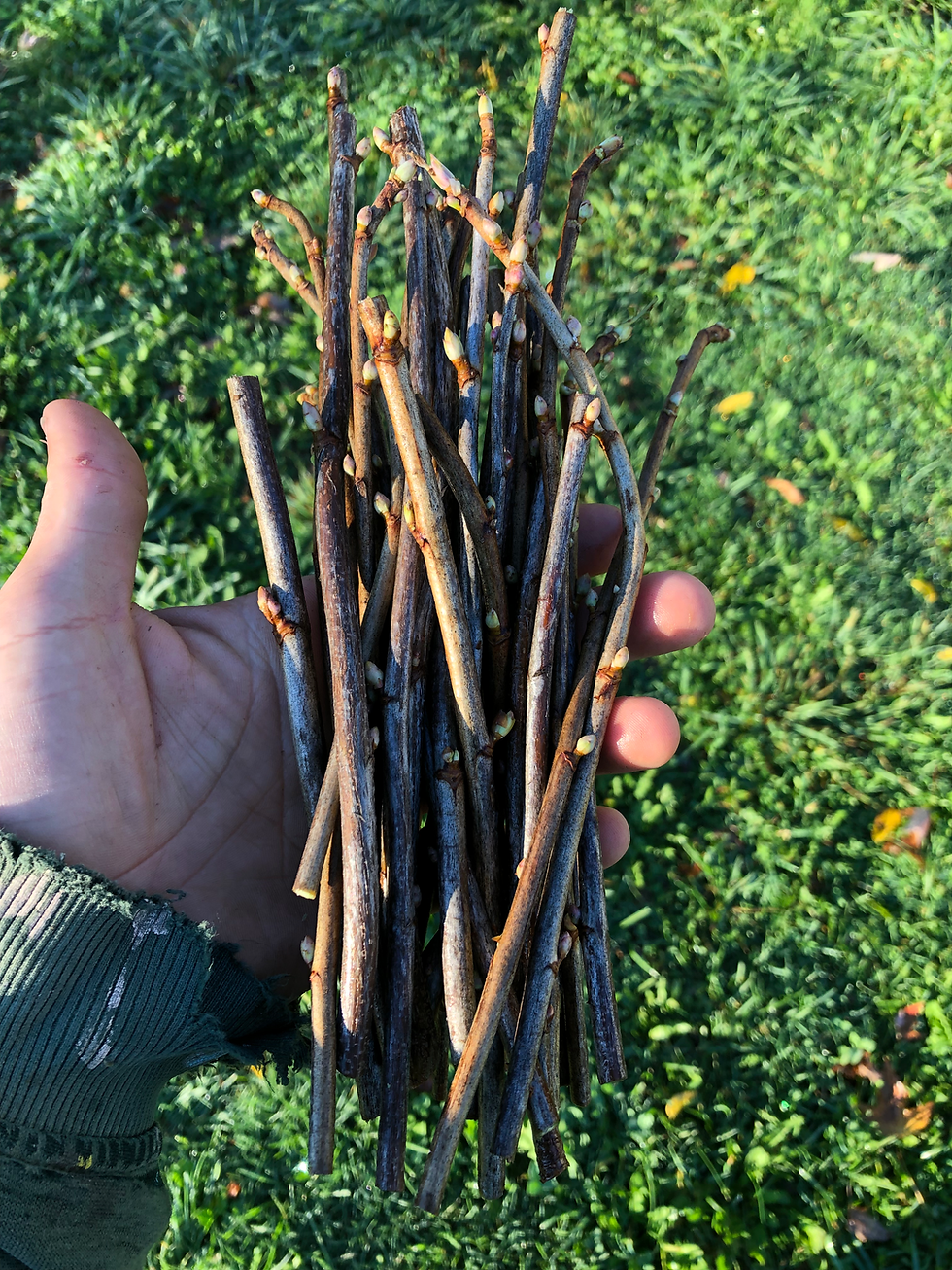
While propagation by dormant hardwood cuttings may seem a bit intimidating if you’ve never done it before, it is one of the simplest ways to propagate certain plants, and is an affordable and easy way to increase your stock for many different species. This post is specifically about dormant hardwood cuttings, as propagation with greenwood/softwood cuttings is a whole different topic. I will be giving a bit of an understanding of hardwood cutting propagation (which I will start to just refer to as “cuttings” from here on out), what is actually happening in the plant, and some species that reliably root from cuttings.
Dormant hardwood cuttings are taken from the desired plant during its dormancy, when it is not actively growing. This is from when the plant’s leaves have dropped all the way through winter until spring when its buds open. Cuttings are are a length of branch or stem that has been cut off of the “mother” plant, with several buds on it. The cuttings are from wood that is about pencil thickness or thicker, varying between species. When buying cuttings they can come in varying lengths. The cuttings we sell are between 6 to 10 inches long.
All cuttings are clones, meaning they are genetic copies of the plant they were cut from. Cloning is a good way to make copies of plants that have a desired trait, like larger than average berries, sweet berries, short or tall growth habit, etc. Some mutation is always possible during cell division as the plant grows, which in theory could make the rooted cutting a genetically distinct individual, but thats a whole different rabbit hole to go down. For simplicities sake, think of the cutting as an exact replica of the plant it came from. Soil conditions, light levels, and other factors can make the traits displayed in clones slightly different from the plant the cutting was taken from.
The benefits of cuttings can also be seen as their down side. Plants that are grown from cuttings don't express the genetic diversity, unique traits, and local adaptations that plants grown from seed do. However, this can be an advantage, as you know what you are going to get as a mature plant from a cutting, which can be useful in small spaces for example, or if you know exactly what characteristics you want.
Some plants that root readily from cuttings are most willow species, poplars, currants, gooseberries, jostaberry, grapevines and elder shrubs, poplar, as well as many others. No rooting hormone is needed!
Species that can root from cuttings without the aid of rooting hormone form what are known as ‘adventitious roots’. This means root tissue can form from other plant tissue, in this case from stem tissue, not only from other root tissue as is the case with typical root growth. The trigger for this adventitious root growth is moisture and soil contact. Pretty remarkable! You may have come across this if you’ve seen shrubs or vines in your garden that have made contact with soil, and when you try to pull on the branch or length of vine that it is firmly rooted in the ground.
Planting cuttings:
All that is required is sticking the cutting into the ground a few inches deep and walking away. If the soil you are planting into is firm, you can loosen it first or dig a slit with a spade to slide the cutting into. The more stem in the earth, the better. Make sure you leave at least one bud (more than one is ok) exposed to the air, as this is where the new above ground growth will start from. It is good practice to mulch around the cutting. The key to getting your cuttings to root is to ensure the soil around it stays moist. Too dry and the cutting will dry out and die, while if the soil is too soggy there is the risk of low oxygen around the root zone which can cause the base of the cutting to rot. With the species mentioned above, cuttings should root at rate of 80-100% in ideal conditions. The cutting will grow roots first, then begin to put on top growth, and actually grow quite quickly!
An important thing to know if you are not planning on planting your cuttings soon after taking them from a plant, or if you receive them from us or another nursery, is to keep them cool, and the bottom end (the end that is closest to the parent plant’s root system) moist. You can do this by wrapping the ends of the cuttings in paper towel or newspaper, dampening it, and wrapping the cuttings in a plastic bag then putting them in your fridge. You can also store cuttings taken in the autumn outdoors with most of the lower part of the sticks covered in mulch or sawdust. You just don't want the pile of mulch or sawdust to heat up too much as this can trigger rooting.
Taking dormant hardwood cuttings is leveraging a plants ability to form adventitious roots for our own purposes, namely to make more plants and get more yields!


Comments